Physical Address
304 North Cardinal St.
Dorchester Center, MA 02124
Physical Address
304 North Cardinal St.
Dorchester Center, MA 02124

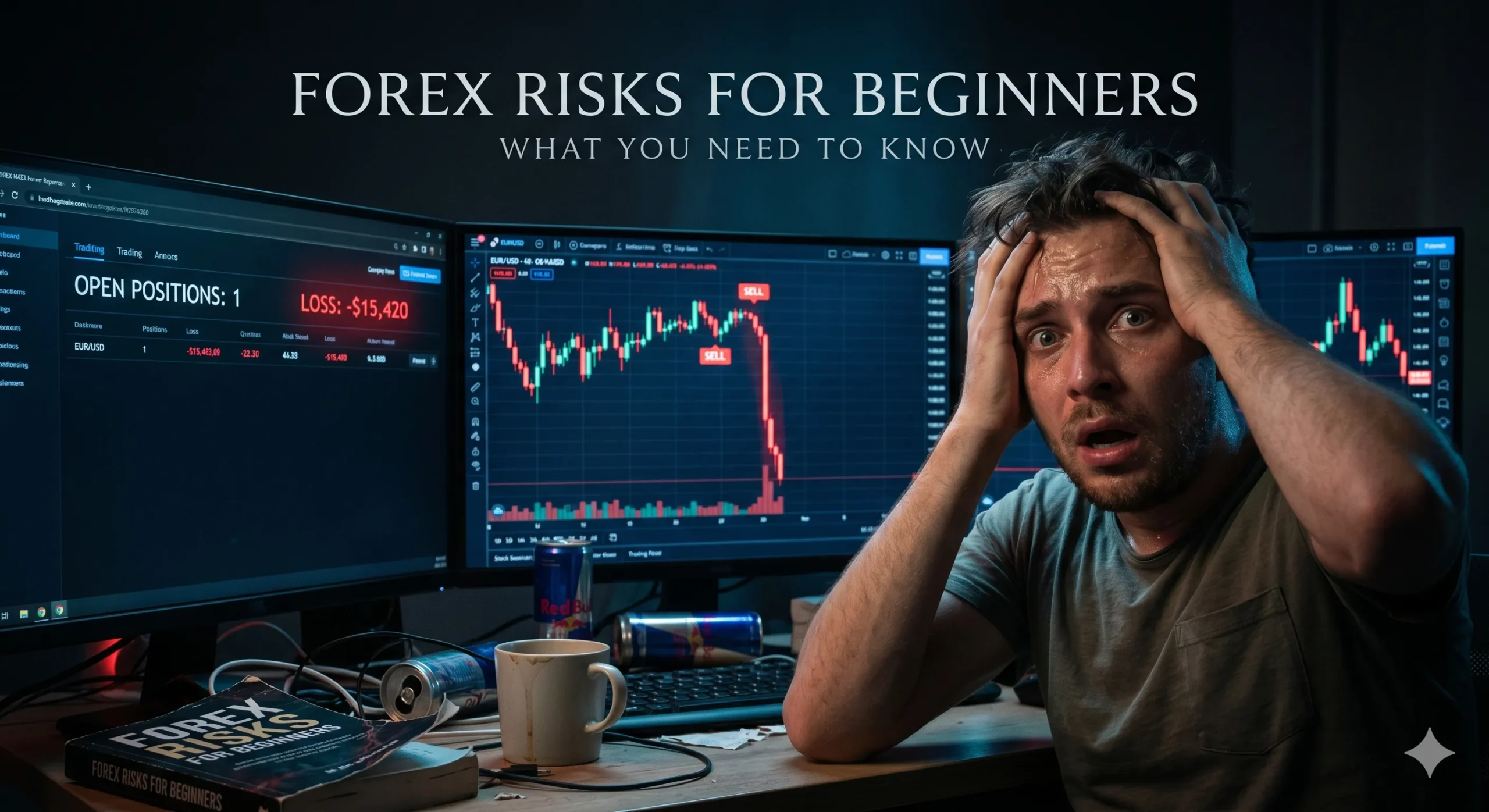
Understanding forex risks for beginners is the absolute first step. Everyone must take this step before diving into currency trading. The foreign exchange market offers massive financial opportunities. However, it also carries a tremendously significant potential for capital loss. You must not enter entirely unprepared. Many new traders jump into this arena blindly. They often fail to realize how aggressive the market can be. This inevitably leads to rapid account depletion. Learning about these hazards early on builds a solid foundation. You can craft a defensive strategy and navigate the complex charts with confidence. This comprehensive guide will walk you through the most critical market pitfalls. It will also show you the exact methodologies to protect trading capital from severe losses.
The foreign exchange market operates twenty-four hours a day, five days a week. This makes it the absolute most liquid financial market in the world. This immense high liquidity ensures instantaneous trade entries and exits. However, it also creates an environment ripe for sudden and unpredictable price spikes. Massive economic news releases, unforeseen geopolitical events, and major central bank interest rate decisions can cause severe volatility within mere seconds. These rapid shifts are prime examples of forex risks for beginners. Inexperienced traders often panic when the market moves aggressively against their open positions.
The global banking system ensures the market never sleeps during the week. Consequently, currency prices can change significantly while you are fast asleep. A trading position might look highly profitable on Friday evening. However, it might unexpectedly gap against you when the market reopens on Monday morning. This constant, unyielding movement demands incredibly strict risk management protocols and unwavering emotional control. You must be completely prepared for an unavoidable mathematical fact. Currency pairs will not always behave rationally or perfectly follow your technical analysis patterns.
Leverage is a mechanism that allows you to control a massive position size with a relatively tiny amount of actual capital. Consider a standard 100:1 leverage ratio as an example. This means you control $100,000 using only $1,000 of your deposited money. This mathematical advantage sounds incredibly appealing for maximizing daily profits. However, it is equally powerful in amplifying your financial losses. In fact, the misunderstanding and blatant misuse of leverage is widely considered one of the most dangerous currency trading risks, often causing new traders to completely blow up their brokerage accounts.
When you utilize excessively high leverage, even a microscopic market movement against your directional bias can instantly wipe out your entire account balance. Brokerages may issue a margin call and forcefully automatically close your active trades if your unrealized losses exceed your available margin limits. You must fully understand how to accurately calculate your position sizing. Intentionally limiting your leverage usage is also a non-negotiable skill for long-term survival.
When looking at the much broader financial landscape, trading international currencies is vastly different from traditional, long-term investing. Buying and holding publicly traded shares means you own a fractional piece of that business. Historically, the general market trajectory trends upwards over extended multi-year periods. In stark contrast, retail forex trading is primarily a highly speculative exchange of one country’s currency against another. There is absolutely no underlying asset creating inherent tangible value over time. This makes it a pure zero-sum game in many functional respects.
This distinct functional difference is crucial. It is exactly why evaluating traditional asset investments alongside currency speculation is essential. When you trade currencies, you are attempting to rapidly profit from short-term mathematical fluctuations rather than relying on long-term global economic growth. Consequently, the forex risks for beginners are fundamentally different from the standard risks associated with holding a passive, diversified retirement portfolio. You are no longer acting as a passive investor. Instead, you are operating as an active day-to-day manager of raw risk and mathematical probability.
One of the absolute fastest ways to lose large sums of money is falling victim to insidious emotional and psychological trading traps. For example, immediately after experiencing a surprisingly painful financial loss, many novices inevitably attempt “revenge trading.” They forcefully open a brand new, often much larger position. This is a desperate attempt to immediately win back the lost money. This visceral emotional response completely bypasses all logic. It almost universally results in even deeper financial devastation.
Another truly catastrophic execution error is actively failing to use a hard stop-loss order on every single trade. A stop-loss physically acts as an automatic safety net that instantly closes your trade when price action reaches a predetermined negative threshold. Operating without one exposes you to theoretically unlimited downside, which is undisputedly one of the most severe forex risks for beginners. Additionally, trading the live markets without a thoroughly tested, written trading plan means you are relying purely on guesswork and hope rather than a definable statistical edge. To properly learn more about mastering your mindset and systematically avoiding these psychological trading traps, aggressively studying behavioral finance is highly recommended.
The single best defense to protect trading capital against the incredibly harsh realities of the currency market is comprehensive, unyielding education. Before risking a single penny of your real money, you must dedicate significant time to understanding core market principles through a highly structured and disciplined academic approach. Actively learning how to read candlestick charts, accurately interpret macro-economic data releases, and master trade management will meticulously build the psychological resilience required to survive your difficult first year as a trader.
Equally critical to your longevity is the mandatory use of a simulated demo account. A reliable demo account directly allows you to practice executing live trades with fake, simulated money in real-time market conditions. It serves as the perfect digital sandbox to aggressively test your strategies. You can refine your technical rules and fully experience the trading platform. Only after successfully achieving verifiable, consistent profitability on a demo account should you even consider transitioning to live funds, and even then, you must start with micro-lots to actively keep your forex risks for beginners at an absolute minimum.
What is the absolute biggest mistake a completely new trader can make?</p>
The single biggest mistake in this industry is drastically over-leveraging a small account without having a strict, non-negotiable stop-loss placed in the mar
ket. This toxic combination practically guarantees that a novice trader will eventually lose their entire deposited capital when an unexpected, high-impact market spike inevitably occurs.
Can you actually lose more money than you initially deposit into your account?
In certain rare, extreme cases, yes. If the broader market gaps significantly during a major geopolitical news event or over the weekend, your designated stop-loss might experience severe slippage. However, the majority of modern regulated brokers now offer explicit negative balance protection to definitively prevent you from owing the brokerage additional money.
How can I consistently minimize forex risks for beginners effectively?</p>
To successfully minimize your daily exposure, you must always strictly risk less than 1% to 2% of your total account balance on any single given tr
ade. Furthermore, meticulously building a solid foundation by understanding core market principles and thoroughly backtesting your chosen strategy on a demo account will drastically, undeniably improve your long-term odds of market success.